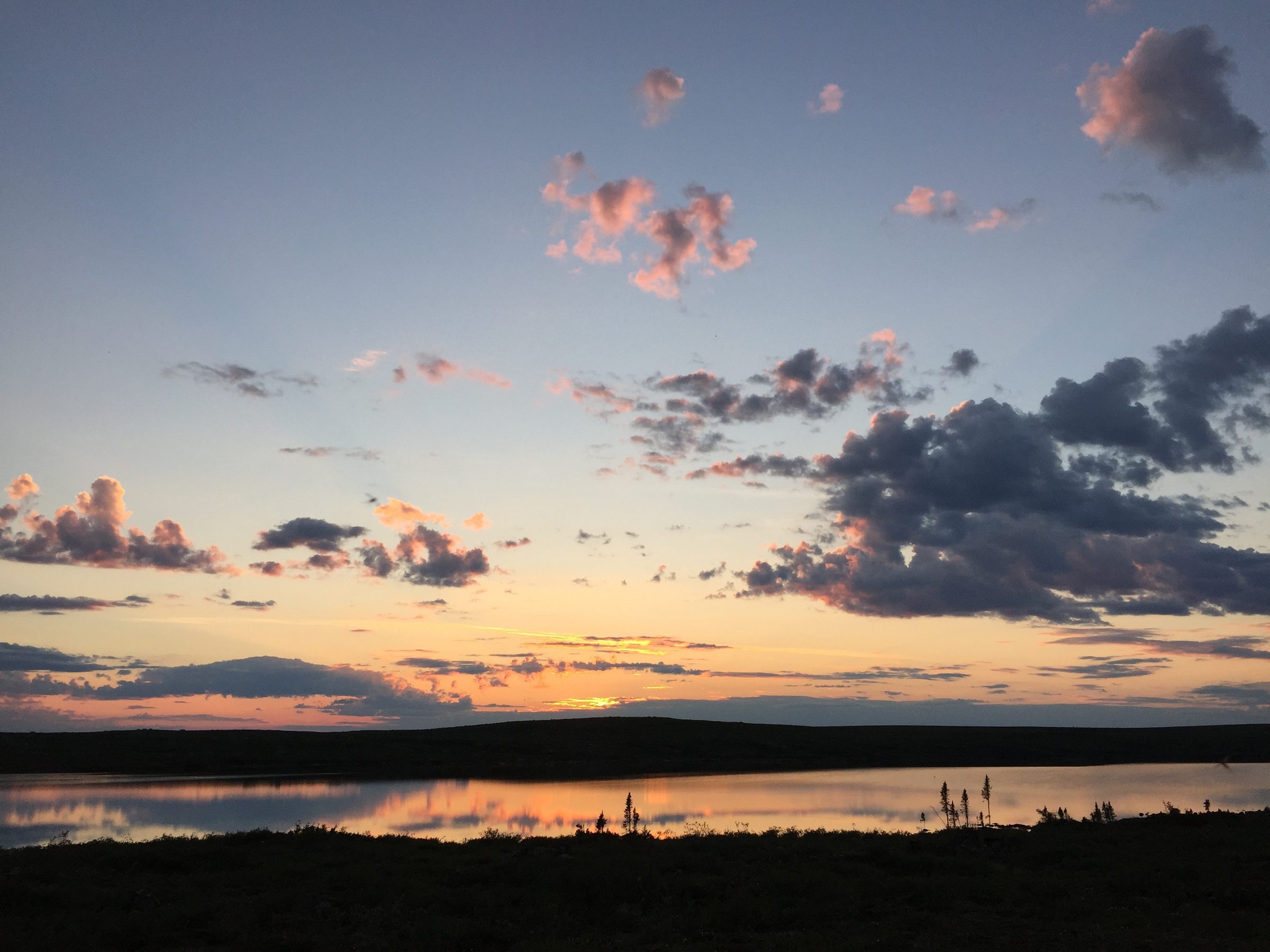
Fox Lake camp · first night on the property · Slave Province, NWT
Neoarchean Orogenic Gold · Slave Craton · NWT

The strongest anomaly on the property has never been drilled.

BNTGold Resources holds 100% of the Fox Lake–Zena property — Neoarchean greenstone in the Slave Craton. Historical 1959 drilling logged visible gold in 17 of 19 holes and returned bonanza grades to 162.5 g/t Au. Only the upper ~75 m has ever been tested.

162.5g/t
Peak gold — DDH-07
historical 1959 assay
17/19
Holes with
visible gold logged
5.3km
Felsite host corridor
traced at surface
~5.7%
Of the corridor drilled
system open at depth

Historical results · 1959 drilling · not NI 43-101 compliant · see disclosure below
Key Highlights

Bonanza grade, a fluid-mixing model, and an undrilled geophysical target.

Nine of nineteen historical holes carry bonanza-class intercepts (≥10 g/t Au). The highest grades occur where two distinct fluids mixed — a pattern that points directly at the next holes.

Open at depth
162.5g/t Au
DDH-07 · Fox Zone

Property-record intercept (sample S703). Coarse visible gold and galena in a quartz reef; DDH-07 alone hosts 7 of the 19 bonanza intercepts within one 200–285 ft reef. Untested down-plunge.

Re-drill priority
98.1g/t Au
DDH-03 · Fox Zone

Main Fox bonanza at 95–96 ft (2.86 oz/short ton). Hole completed to 139 ft; the depth extension below the reef has never been tested. Two LCT pegmatite intervals in the same hole.

Fluid-mixing zone
71.3g/t Au
DDH-04 · Fox Zone

Bonanza with chalcopyrite and a silver co-anomaly (Au:Ag ≈ 1.9:1) inside a muscovite halo — the diagnostic signature of Type-1 + Type-2 fluid mixing, and the highest-priority target style on the property.

Never drilled · T1
52.8mV/V
IP target T1 · Line 3

The single strongest chargeability anomaly in the 2016 survey — stronger than the response over the 162.5 g/t DDH-07 cluster, and best expressed at 100–150 m, below the depth any 1959 hole reached.

Open · Zena
71.3g/t Au
Zena G-1 · 1019 m north

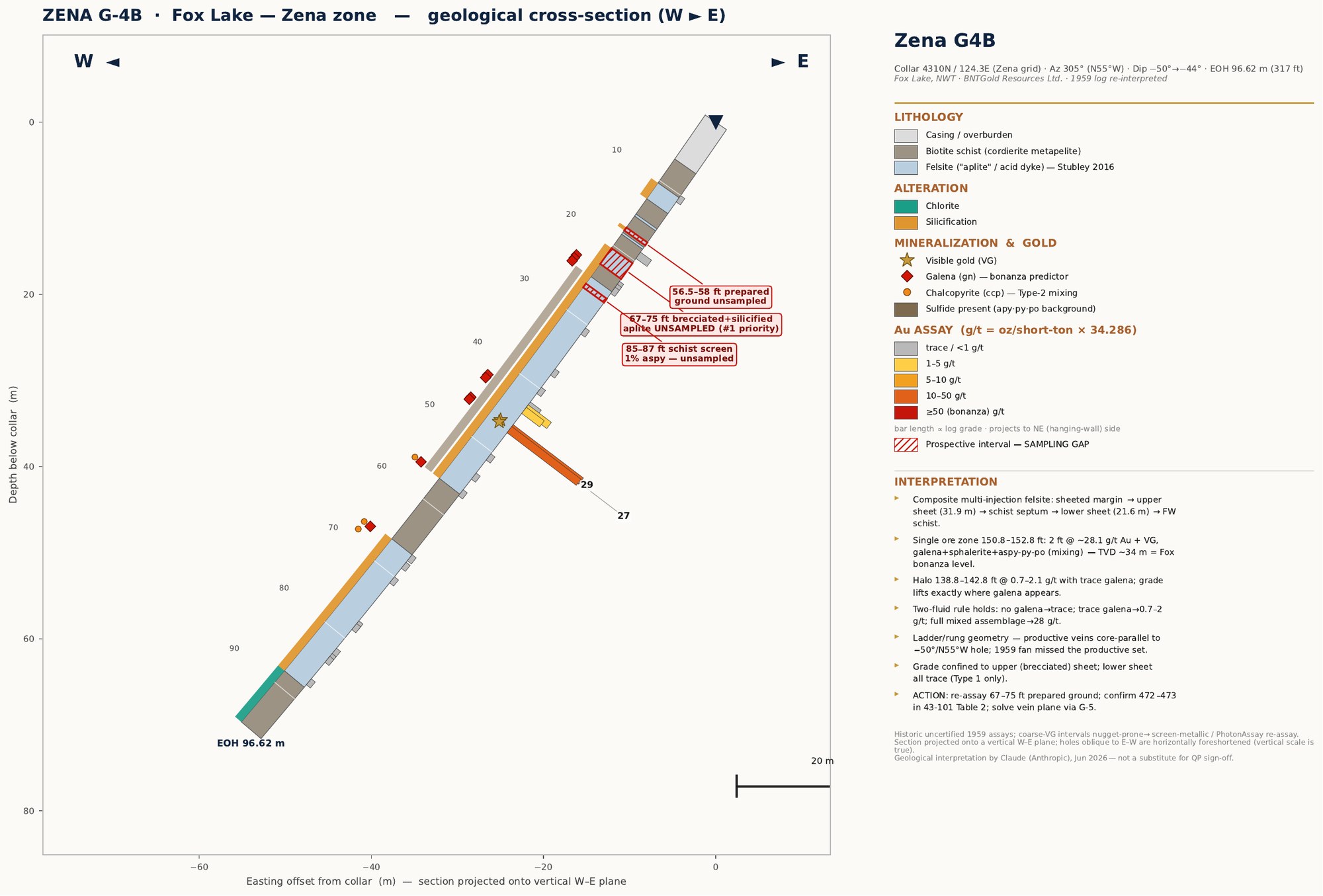
One-foot core within a 24.2 g/t / 3 ft composite in brecciated aplite — the northern continuation of the same mineralised corridor, 1019 m from the Fox cluster and barely tested.

Surface discovery
6,160ppm W
Scheelite — rock geochem

Diagnostic scheelite (CaWO₄) signature in rock chips, with lithium-tantalum (LCT) pegmatite fertility flagged separately. A second and third commodity system, never systematically explored.

The Property

Fox Lake–Zena — 280 km northeast of Yellowknife

The property sits in the southern Slave Craton, the same Archean greenstone setting that hosts the established gold camps of the Northwest Territories. Its structural architecture has never been systematically drilled below ~75 m.

Location
Slave Province, NWT, Canada · NTS 75N · ~280 km NE of Yellowknife
Prospects
Two prospects — Fox + Zena, 1019 m apart
Ownership
100% BNTGold Resources Ltd.
Deposit type
Archean orogenic gold — fold-hinge and fault-reef controlled
Host rock
"Felsite" intrusion (~71% SiO₂, Stubley 2016) — a competency-contrast trap, not S-type granite
Causative fluids
Two-fluid system; the Zyena Lake two-mica granite is a separate pluton to the NW
Ore-shoot plunge
~70° E, parallel to the L2 lineation
Drilled to date
~300 m of strike · max ~75 m vertical depth · open below on all lines
Access
Tibbitt–Contwoyto winter road (Jan–Apr) + floatplane / helicopter
Multi-commodity endowment

One corridor, three mineral systems

Gold is proven by drilling. Tungsten (scheelite) and a lithium–tantalum–caesium pegmatite system are confirmed in surface geochemistry but have never been drill-tested — independent upside on the same ground.

AuGold
WTungsten
LiLithium
TaTantalum
CsCaesium

Lithium potential is expressed as LCT-pegmatite fertility (Be, Ta pathfinders) in rock geochemistry — not a defined spodumene resource.

Regional setting · interactive map Open full map ↗

Fox Lake–Zena sits in the producing heart of the southern Slave Craton — 47 km from De Beers' Gahcho Kué mine and on the Tibbitt–Contwoyto winter-road corridor. Pan and zoom; switch between project, district and region views.

Deposit Model

Bonanza grade is made where two fluids meet.

Fox Lake is an Archean orogenic gold system. The highest grades are not random: they occur where an orogenic gold fluid mixed with a separate magmatic fluid at structural traps in the felsite host. That intersection is the drill target.

Type 1

Magmatic Cu-fluid

  • Chalcopyrite ± pyrite assemblage
  • Background gold only (10–15 ppb)
  • Logged in 10 of 19 holes
  • Produces no economic gold alone
Type 2

Orogenic Au-fluid

  • Pyrrhotite + arsenopyrite + visible gold
  • Bonanza-capable on its own
  • Sources the gold endowment (~2.65–2.60 Ga)
  • Drives the DDH-07 and DDH-09 reefs
Mixing zone

Type 1 + Type 2

  • Bonanza gold + chalcopyrite + silver
  • Muscovite halo on the wall rock
  • Galena marks the highest grades
  • Documented at DDH-04 and DDH-15
★ The highest-priority drill target style
1
~2.7 Ga

D1–D2 metamorphism

Greenstone deformation sets the fabric, L2 lineation and shear architecture that later host fluid.

2
Syn-D2

Felsite intrusion

~71% SiO₂ felsite emplaced and folded — the competency-contrast host for everything that follows.

3
~2.65–2.60 Ga

Gold-fluid event

Orogenic Au-fluid mixes with the magmatic fluid at structural traps. The ore-forming event.

4
~1.27 Ga

Mackenzie diabase

Post-ore dyke swarm cross-cuts and offsets the deposit — it dismembers, but does not source, the gold.

1959 Drilling · Re-compiled

Nineteen holes. Nine carry bonanza gold.

14 Fox holes and 5 Zena holes drilled in 1959, re-logged and re-compiled by the Company's geological team. Nineteen intercepts grade ≥10 g/t Au; seven exceed 30 g/t (~1 oz/short ton). Four bonanza intercepts are absent from the prior 2017 results table.

Grade basis. Original 1959 assays were reported in oz/short ton and are converted to g/t at ×34.286. The 2017 report applied ×31.25, under-reporting all grades by ~9.7%. Depths are down-hole feet as logged in 1959; sample lengths may not represent true width. Original laboratory certificates must be verified before any resource estimate.
HoleZoneIntervalAu (g/t)StatusKey observation
DDH-07Fox240–242 ft162.5OpenProperty record (S703); coarse VG + galena; 7 of 19 bonanza intercepts in one reef
DDH-03Fox95–96 ft98.1Re-drillMain Fox bonanza; hole to 139 ft; depth extension untested; two LCT pegmatites
DDH-04Fox164–166 ft71.3OpenChalcopyrite + Ag co-anomaly in muscovite halo — confirmed fluid-mixing bonanza
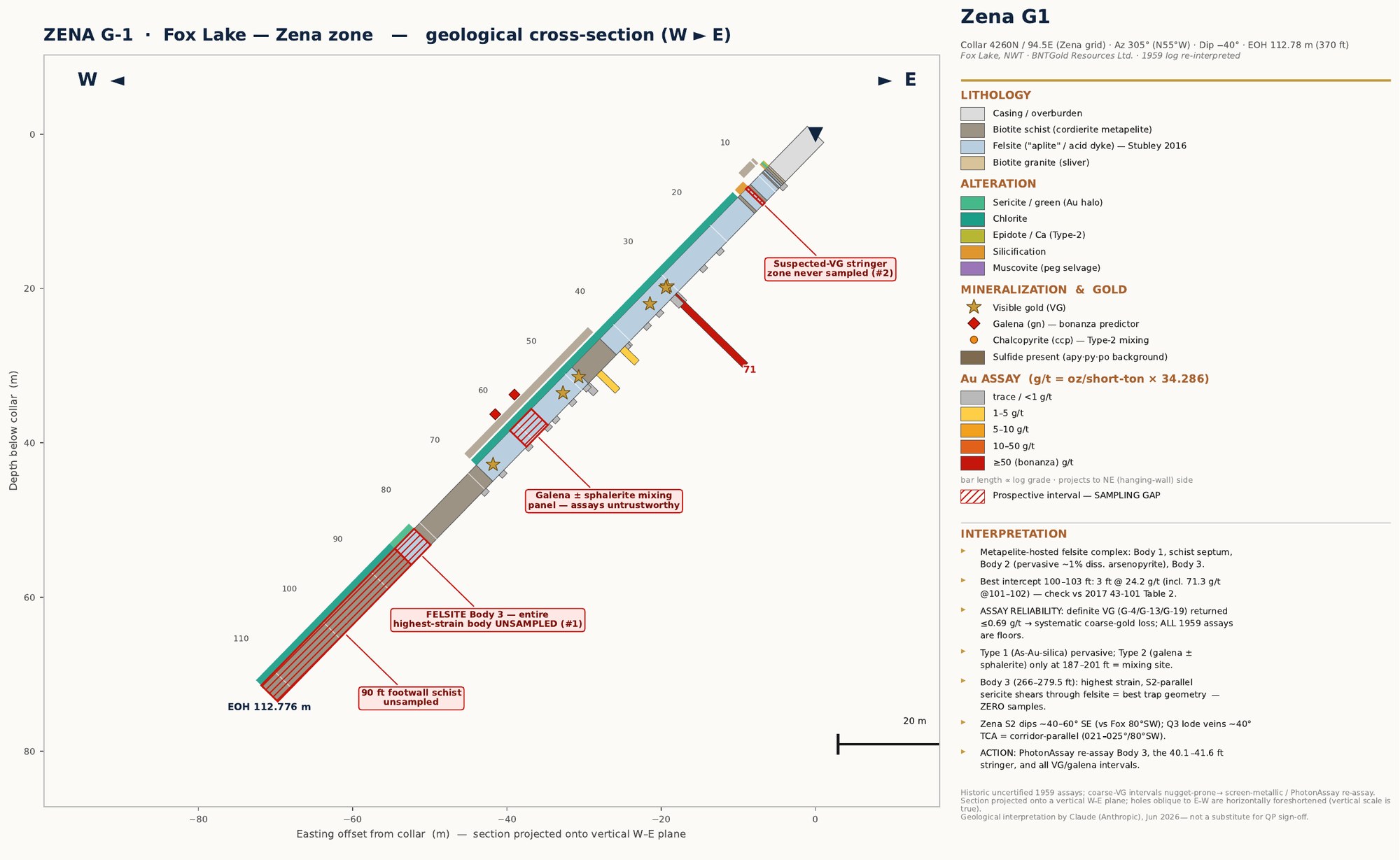
Zena G-1Zena101–102 ft71.3Open1 ft within 24.2 g/t / 3 ft; brecciated aplite; northern corridor
Zena G-4BZena150–153 ft28.8OpenBuilding grade vector; galena + sphalerite + visible gold; D2 augen shear
DDH-09Fox159–160 ft27.4OpenBonanzas above and below the diabase sill; same collar as DDH-03 (omitted from 2017 table)
DDH-05Fox58–59 ft26.7OpenTourmaline pegmatite vein; LCT + bonanza at the contact
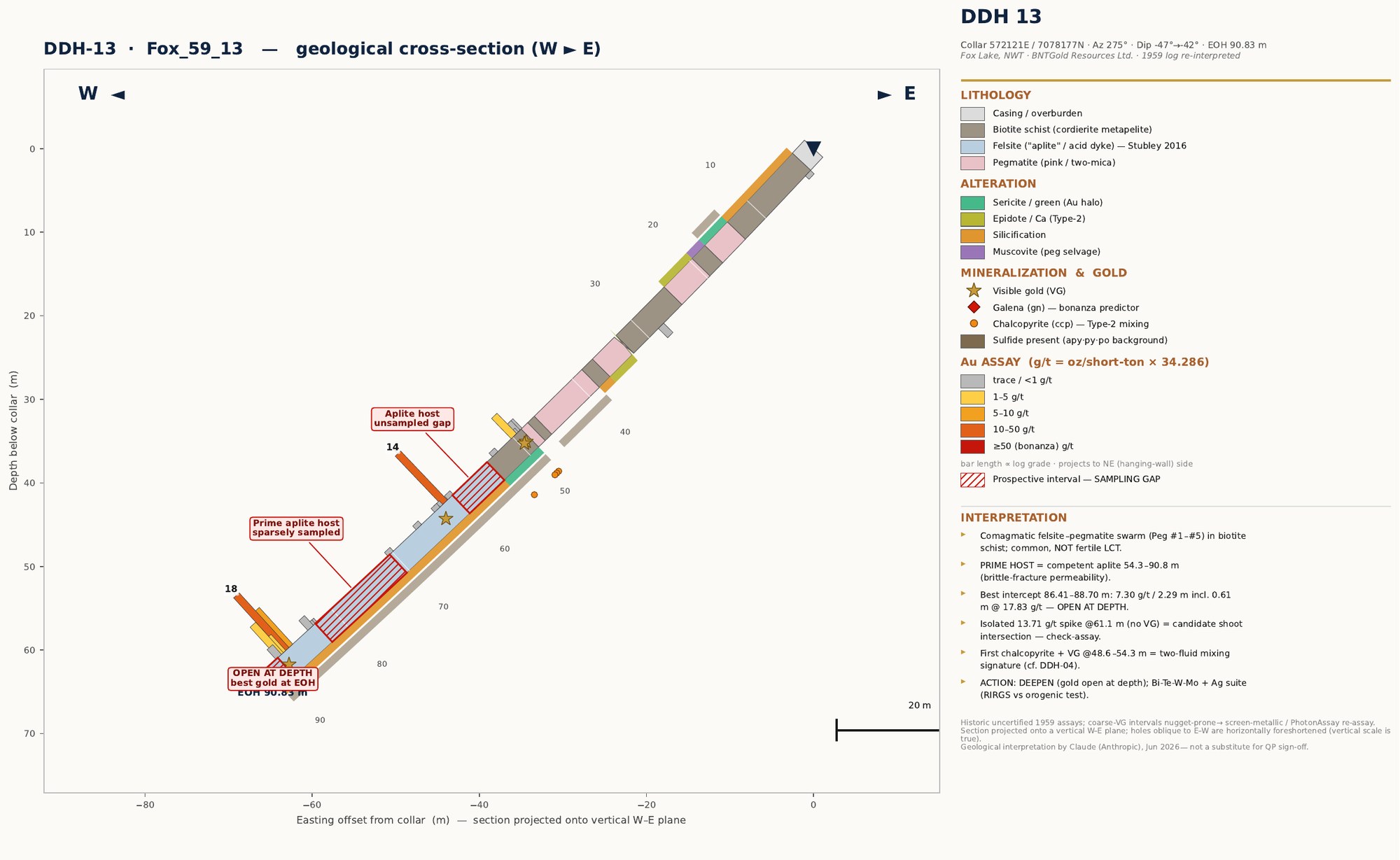
DDH-13Fox286–288 ft17.8OpenDeep eastern intercept; two bonanzas in aplite; open at depth
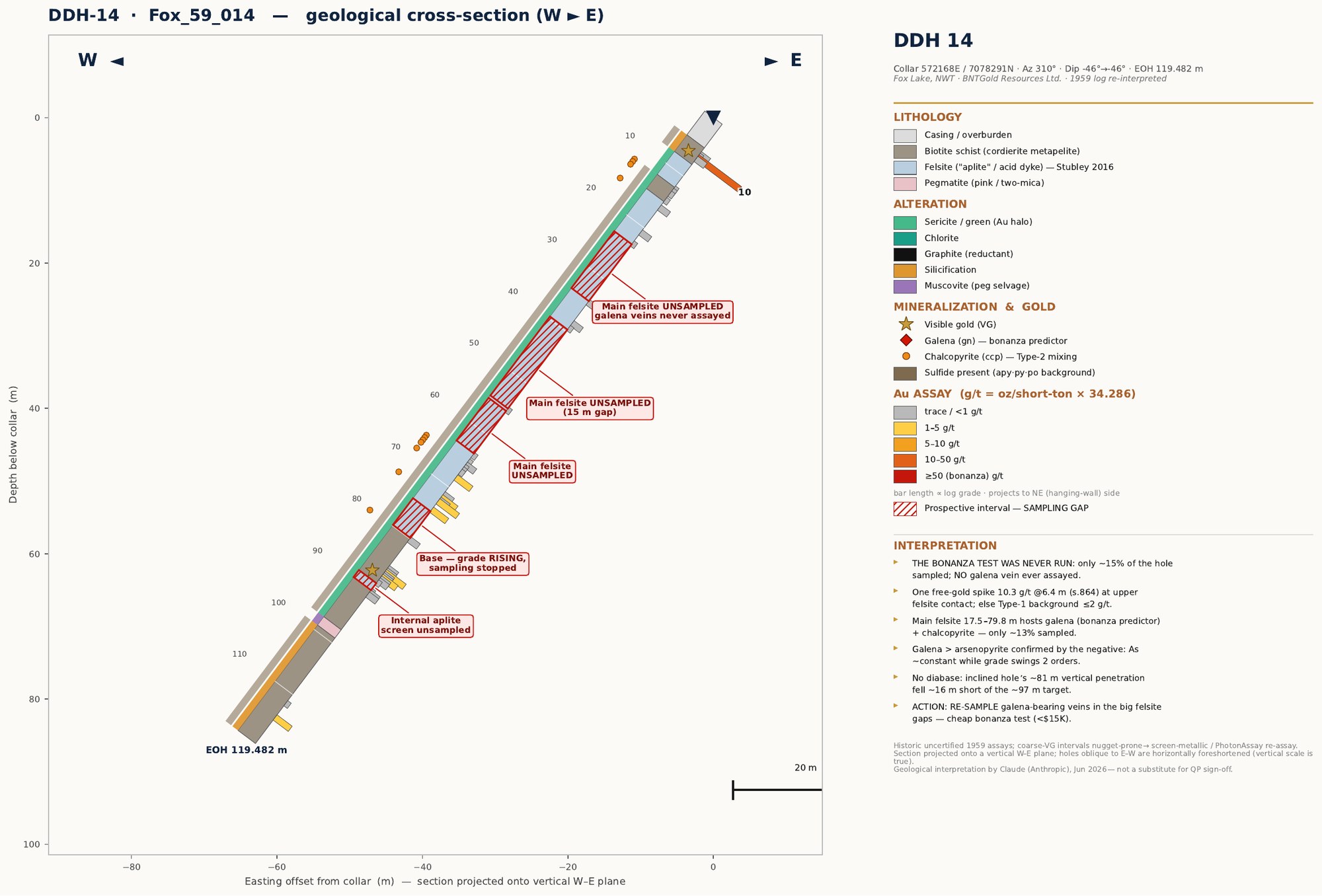
DDH-14Fox (Loc C)20–22 ft10.3Re-assayVisible gold; 69–208 ft interval was never assayed — chalcopyrite + rising Au throughout

Nine of the nineteen holes carry bonanza intercepts (≥10 g/t Au); table shows the highest grade per hole. Visible gold was logged in 17 of 19 holes.

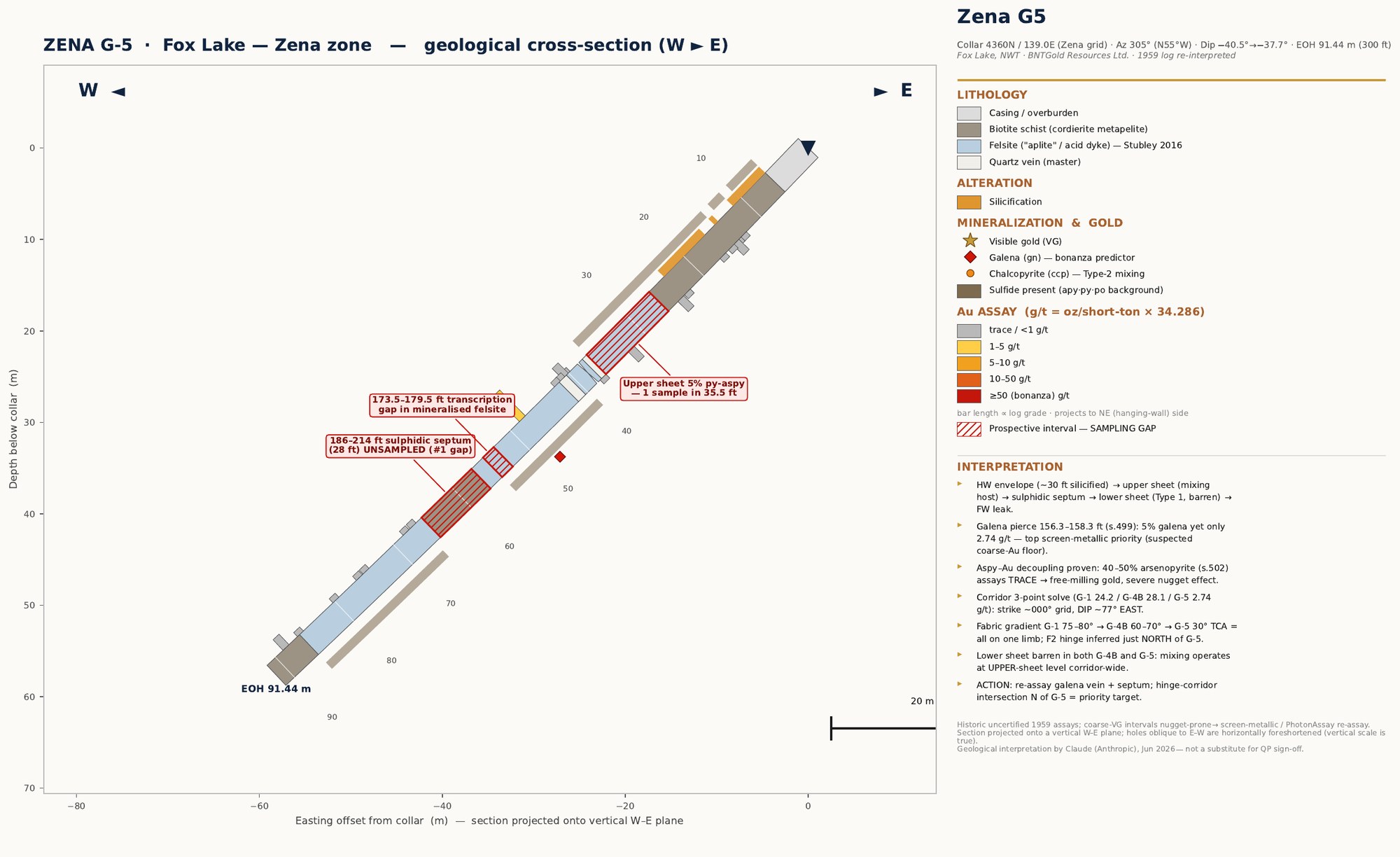
Re-interpreted cross-sections

Every 1959 hole, re-logged in a single house style.

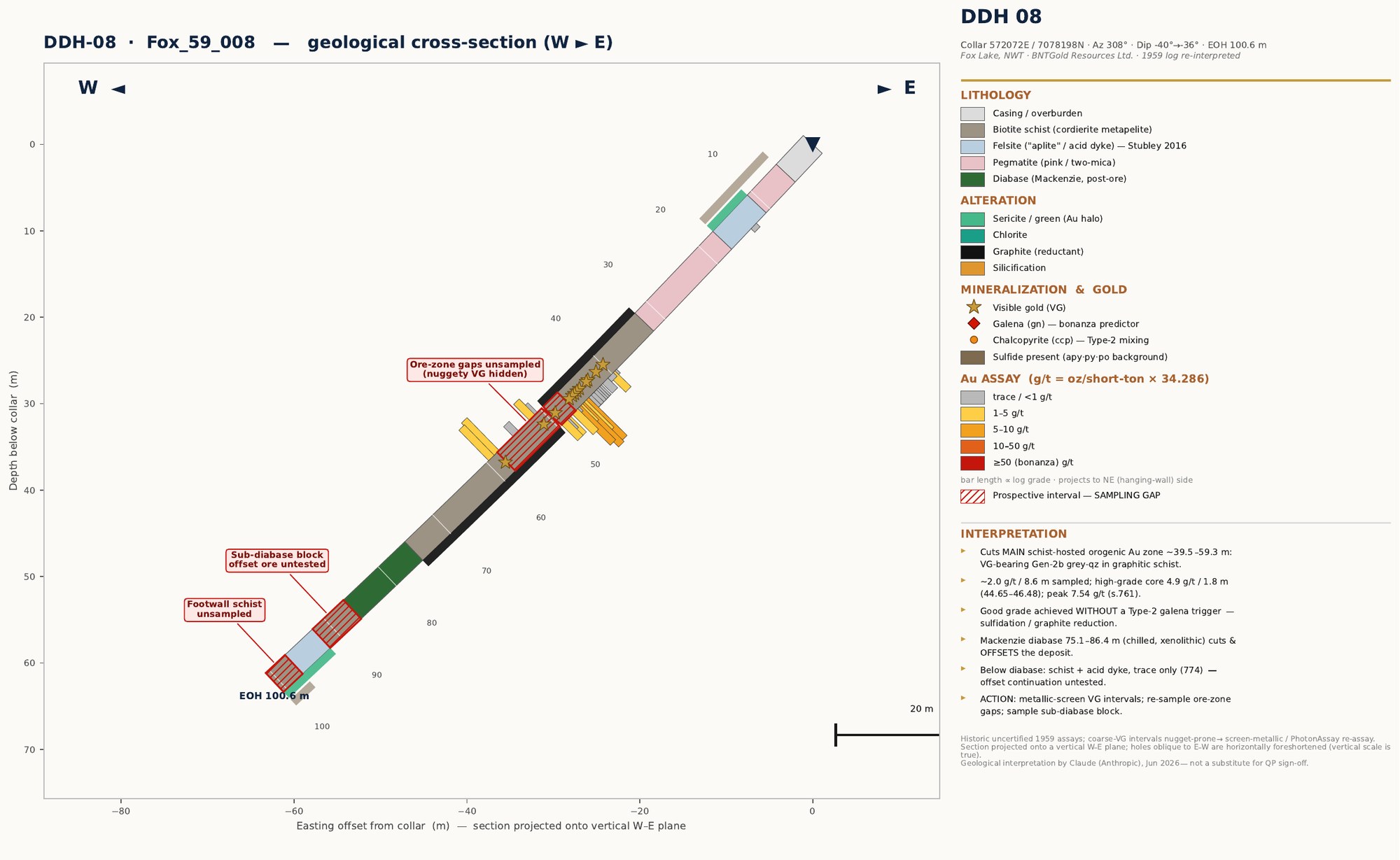
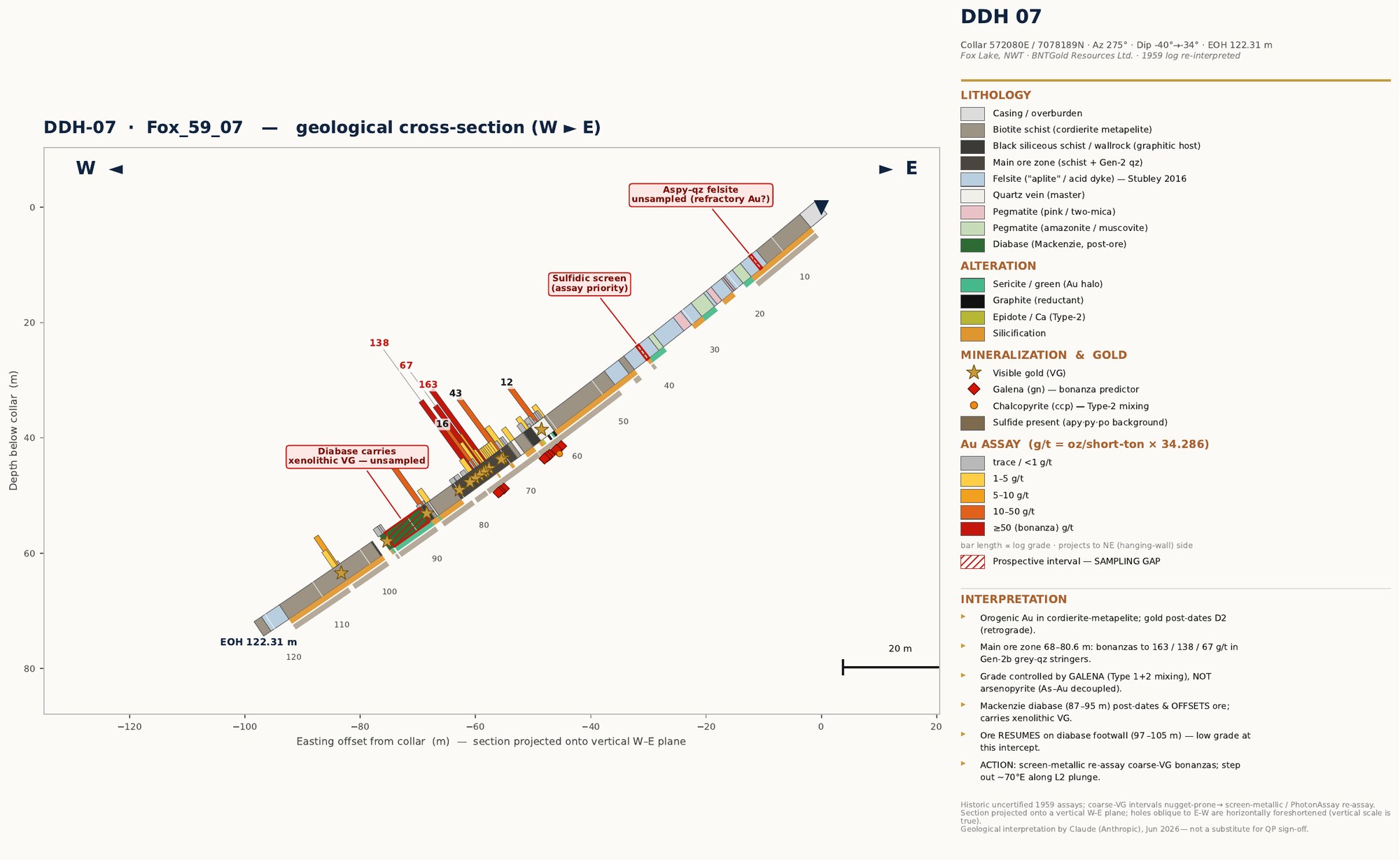
Lithology, alteration, mineralisation and assay grade plotted to a common projection. The hatched intervals are the story: prospective rock the 1959 crews logged but never assayed — the bonanza test that was never run.

DDH-07 geological cross-section showing bonanza gold intercepts in the main ore zone
DDH-07 · Fox_59_07 · property record

The reef that hosts 7 of 19 bonanza intercepts

Bonanzas to 163 / 138 / 67 g/t in Gen-2b grey-quartz stringers (68–80.6 m), grade controlled by galena, not arsenopyrite. The Mackenzie diabase offsets the ore and carries xenolithic visible gold; ore resumes on its footwall. Open down-plunge to ~70° E.

↓ Download all seven sections (PDF) Interpretation by the Company's geological team, 2026 — historical 1959 data, not a substitute for QP sign-off.
Explore the holes in 3D

Drill traces, lithology and the sampling gaps — in three dimensions.

Composite 3D models of the Fox and Zena fans. Rotate to see how the holes stack, where the felsite host runs, and how much prospective rock was left unsampled below ~75 m.

Fox zone · 3D composite Fullscreen ↗
Zena zone · 3D composite Fullscreen ↗

Models are large interactive files — drag to rotate, scroll to zoom. If a frame loads slowly, open it fullscreen in a new tab.

Geophysics · 2016 IP + 2024 Magnetics

The geophysics points below the 1959 holes.

A 2016 induced-polarisation survey and a 2024 magnetic inversion both define targets beyond the reach of the historical drilling — including the strongest chargeability anomaly on the grid, which has never been tested.

Induced polarisation — 5 ranked targets

12 lines, 26 catalogued anomalies. For this silicification-positive system, a silicification-weighted chargeability vector — not the standard Metal Factor — is the correct guide to the gold.

  • T1Line 3 — undrilledStrongest chargeability on the grid; best at 100–150 m52.8 mV/V
  • T2Line 3/4 — down-plungeContinuation ~150 m below any 1959 holeuntested
  • T3Line 1 — near drillingAdjacent to the Fox bonanza clusterpriority B

Magnetics — three bodies, one target

A 3D susceptibility inversion of the 2024 aeromagnetic survey resolves three discrete magnetic bodies within 2.5 km of drilling. Reduced-to-pole products are displaced ~305 m southeast by remanent magnetisation — a correction the targeting accounts for.

  • B3Body 3 — Priority A799 m NE, on the Fox–Zena corridor, along strike from drilling+0.026 SI
  • B1Body 1 — Priority BSeparate sub-parallel corridor to the west+0.052 SI
  • B2Body 2 — third corridorLowest priority of the three+0.039 SI
Surface Geochemistry

Six survey media. One target.

A 496-sample dataset across six sample media — till, soil, rock chip and more — independently converges on a single bonanza target, while flagging two further commodity systems on the same ground.

Gold
12.25g/t Au
Rock chip V408516

Peak rock-chip gold; a visible-gold rock sample (S341685) returned 7.16 g/t. All six media converge on one target near 572,074 E / 7,078,125 N.

Tungsten
6,160ppm W
Scheelite signature

Diagnostic CaWO₄ chemistry (high W + Ca, low As) in rock geochemistry — a tungsten target flagged for short-wave UV follow-up, never drill-tested.

Lithium · Ta · Cs
173ppm Be
LCT pegmatite fertility

Garnet pegmatite and muscovite-granite rock chips (Be to 173.5, Ta to 18.6 ppm) plot inside the productive LCT field — a lithium–tantalum pegmatite system worth testing.

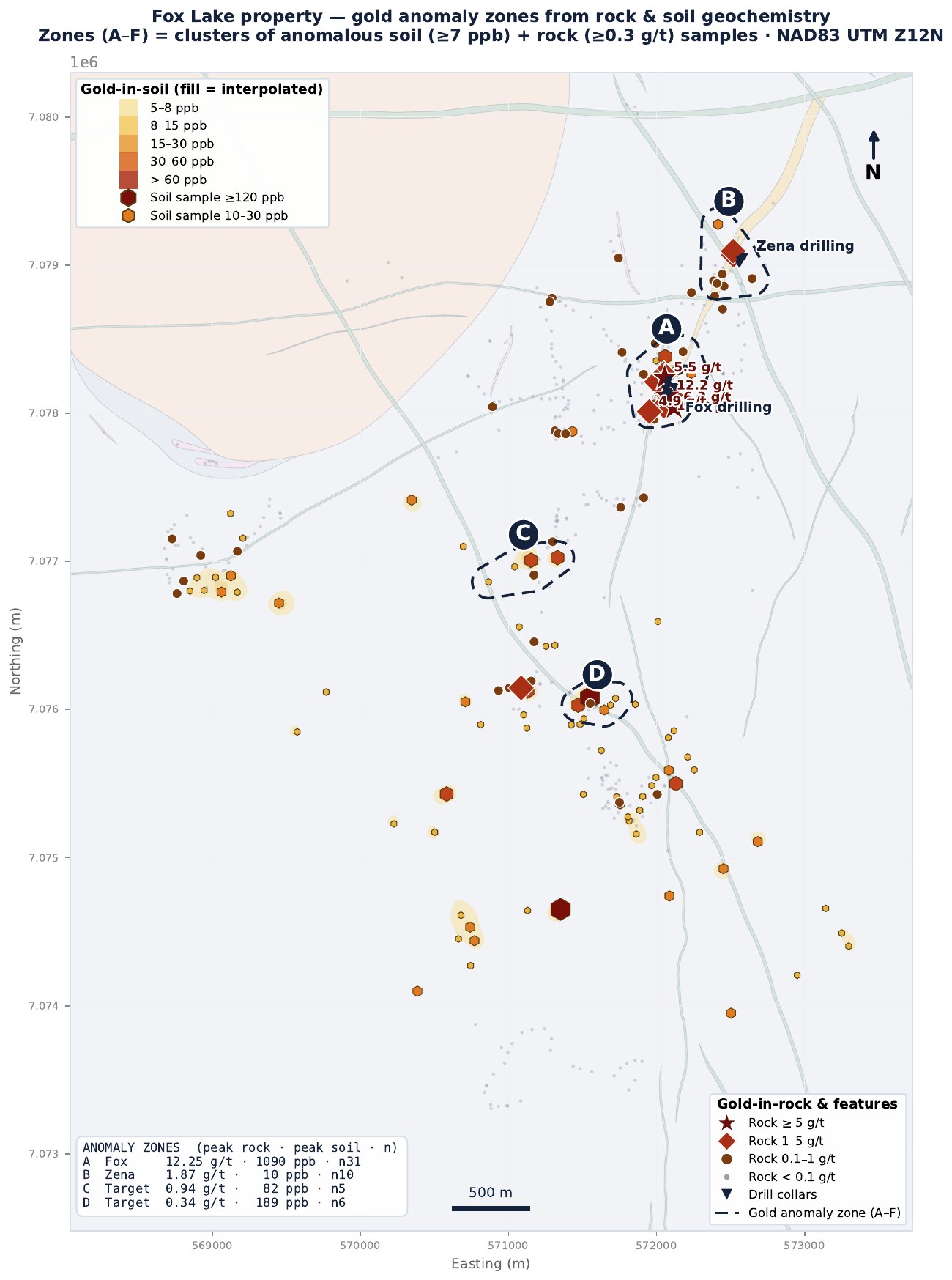
Gold anomaly zone map showing clusters A–D over the Fox and Zena prospects
Gold · rock + soil

Four anomaly zones, drilling on the strongest.

Clusters of anomalous soil (≥7 ppb) and rock (≥0.3 g/t) define four zones. Zone A — the Fox cluster — peaks at 12.25 g/t in rock and 1,090 ppb in soil, directly over the historical drilling. Zones C and D are untested targets on the same trend.

AFox cluster · over drilling12.25 g/t · 1090 ppb · n31
BZena · northern corridor1.87 g/t · 10 ppb · n10
CTarget · undrilled0.94 g/t · 82 ppb · n5
DTarget · undrilled0.34 g/t · 189 ppb · n6
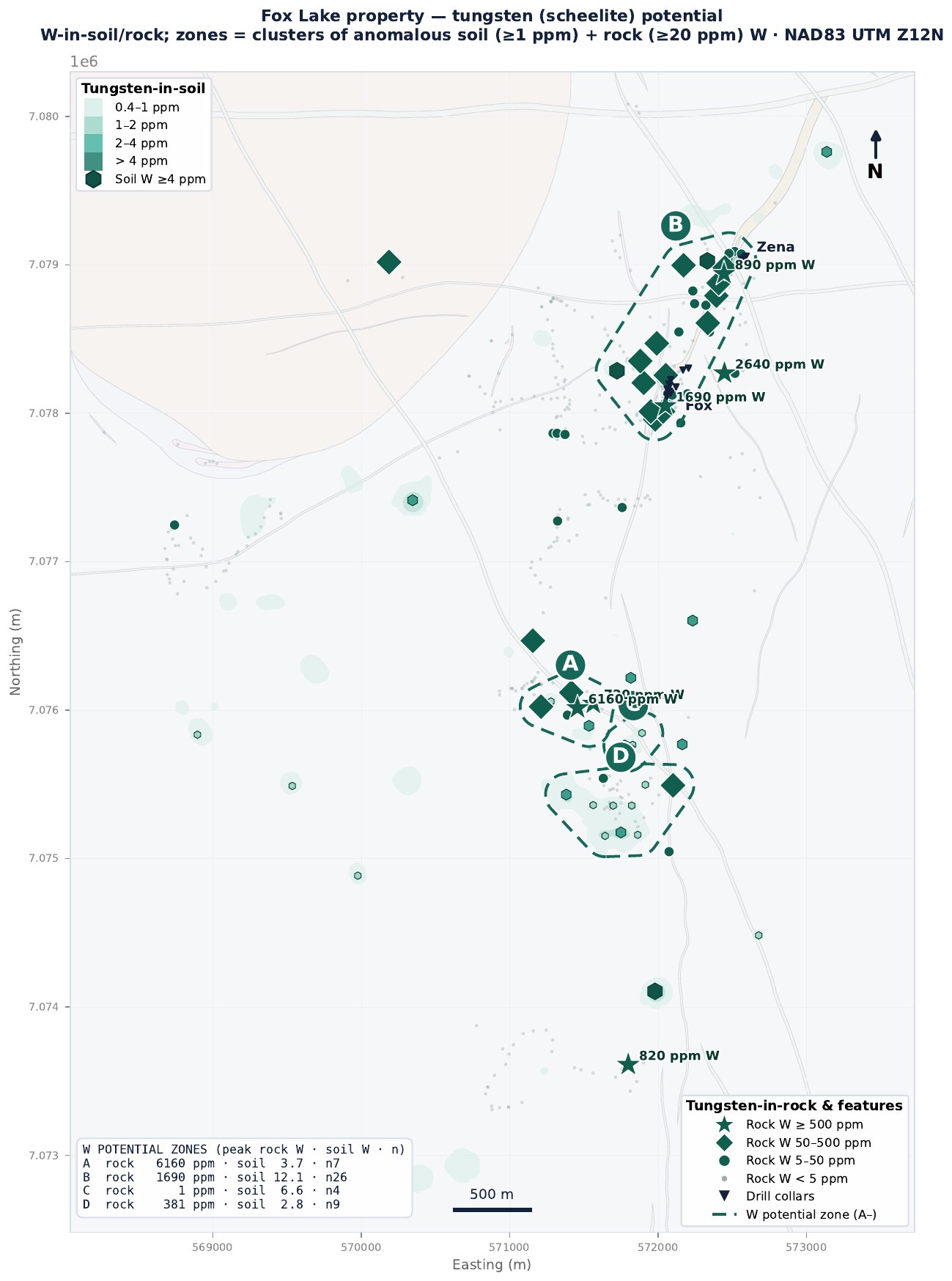
Tungsten · scheelite

A second metal, peaking at 6,160 ppm W.

Anomalous tungsten in soil (≥1 ppm) and rock (≥20 ppm) traces a strong cluster (Zone B) right through the Fox–Zena corridor, with a separate high-grade zone (A) to the south. A diagnostic scheelite signature, flagged for short-wave UV follow-up and never drill-tested.

ASouthern · peak rock6,160 ppm · soil 3.7
BFox–Zena corridor1,690 ppm · soil 12.1 · n26
DSouthern soil zone381 ppm · soil 2.8 · n9
Tungsten potential map showing scheelite anomaly zones
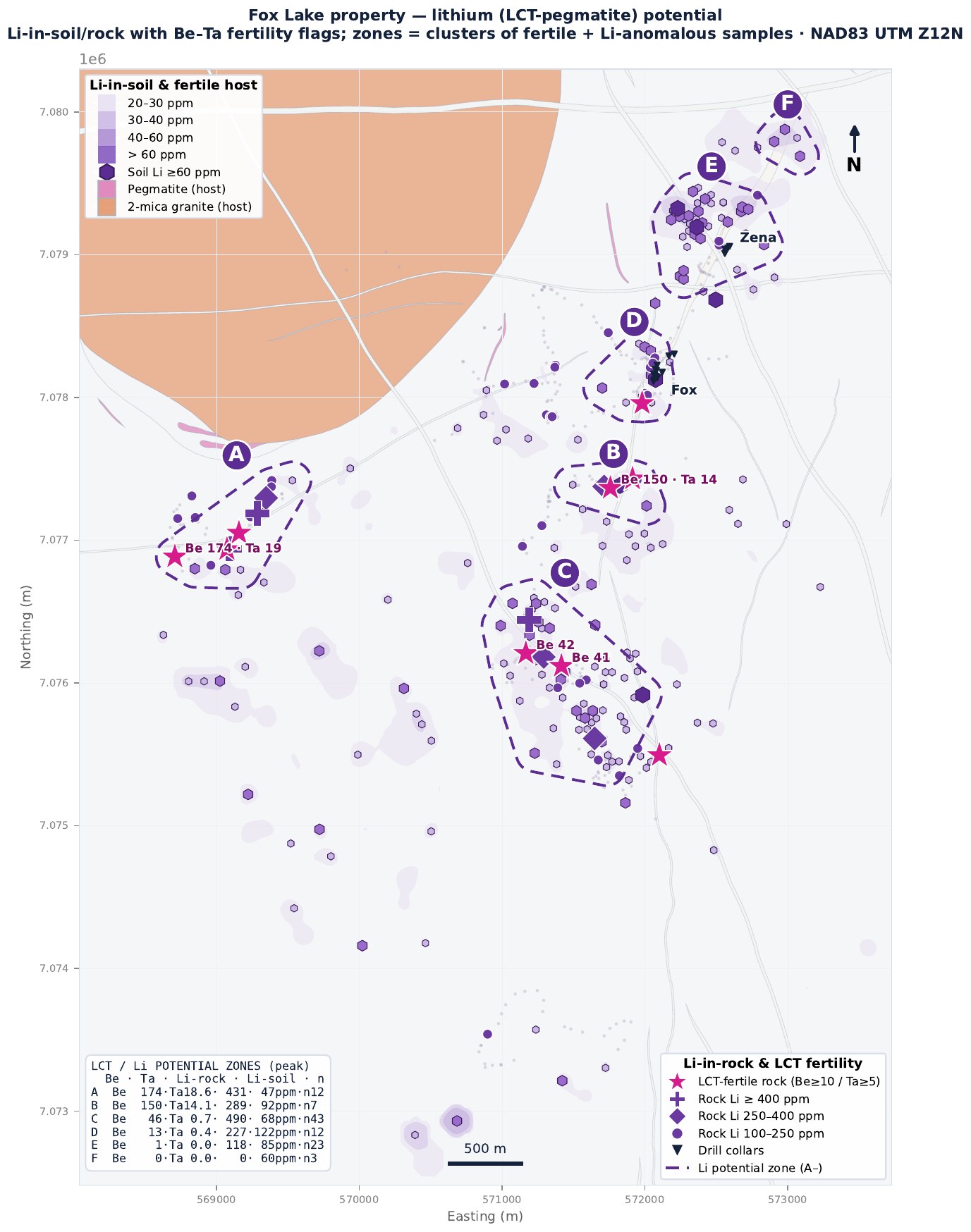
Lithium LCT-pegmatite potential map with Be and Ta fertility zones A–F
Lithium · tantalum · caesium

Two LCT-fertile pegmatite zones, spatially distinct from gold.

Beryllium and tantalum pathfinders flag genuinely fertile pegmatite: Zone A (Be 174, Ta 18.6) and Zone B (Be 150, Ta 14.1) plot inside the productive LCT field. Unlike the gold and tungsten targets, the fertile pegmatites sit on their own trends — independent commodity upside.

AWestern · most fertileBe 174 · Ta 18.6 · n12
BCentral · fertileBe 150 · Ta 14.1 · n7
CHigh Li, low fertilityLi 490 ppm · Ta 0.7 · n43
Path Forward

A phased programme — cheapest, highest-confidence tests first.

The plan starts with low-cost validation that can be completed before any new drilling, then steps out to the down-plunge and undrilled geophysical targets.

Phase 1 · 0–3 months

Validation

low cost · no drilling
  • Re-assay the unassayed 69–208 ft of DDH-14
  • Verify original 1959 laboratory certificates
  • Compile structure for shoot wireframing
Phase 2 · 3–9 months

Define & extend

first new drilling
  • 8–12 holes down-plunge of the Fox shoots
  • 3–5 step-out holes at Zena and Loc C
  • Test IP target T1 and magnetic Body 3
Phase 3 · 12–24 months

Resource definition

toward a maiden resource
  • Infill drilling on confirmed shoots
  • Bulk sampling for metallurgy
  • NI 43-101 maiden resource estimate
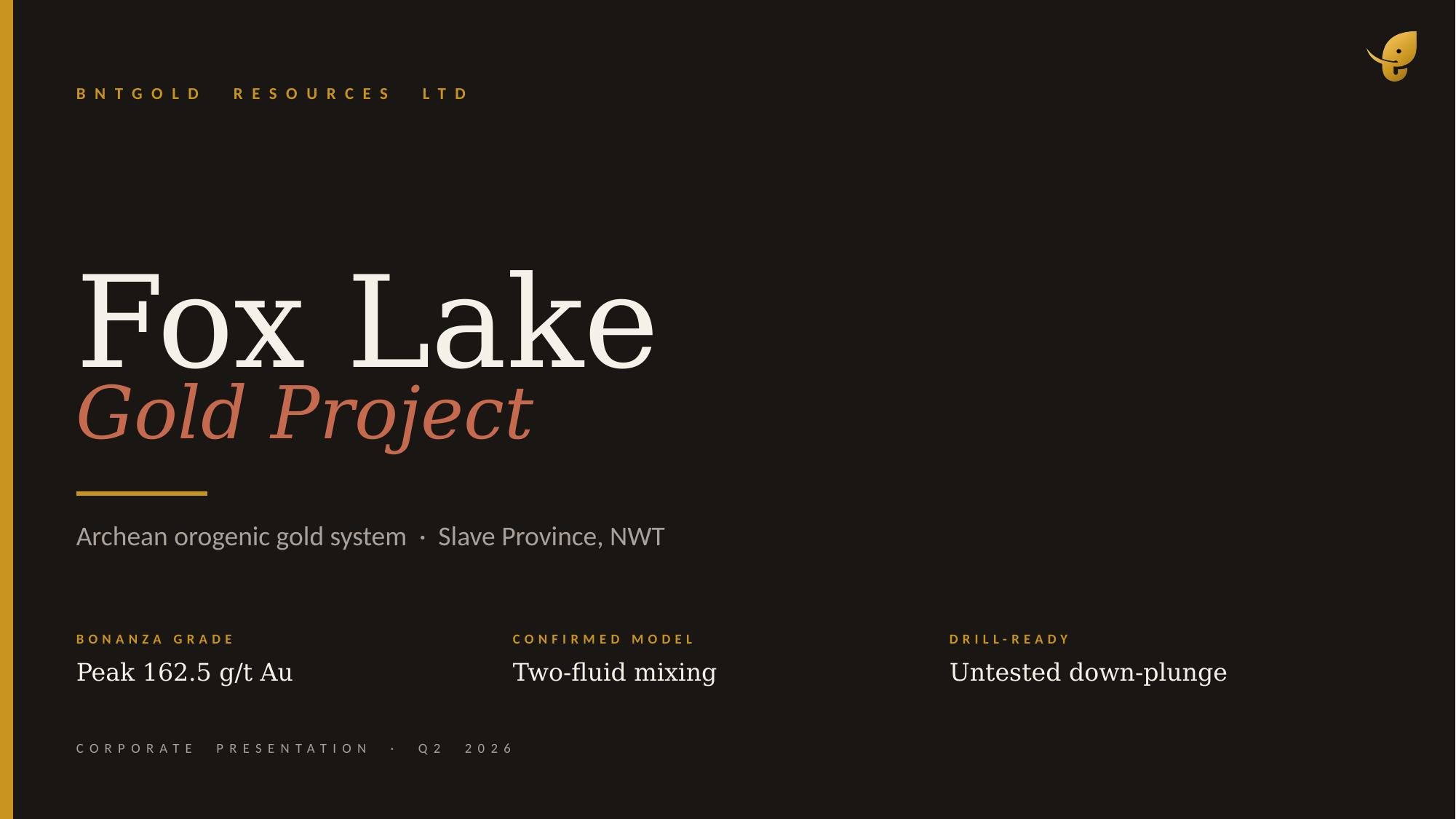
Fox Lake Gold Project — corporate presentation cover slide
Corporate presentation · Q2 2026

The full Fox Lake story, in 17 slides.

Location and district setting, the two-fluid deposit model, the re-compiled 1959 bonanza dataset, the undrilled IP and magnetic targets, and the phased path to a maiden resource — the complete investor deck.

17 slides · 4 MB PDF · historical 1959 data, not NI 43-101 compliant
Investors & Partners

A drill-ready Archean gold system, available for technical review.

BNTGold Resources Ltd. is advancing the Fox Lake–Zena property toward a maiden resource. We welcome enquiries from investors, joint-venture partners and qualified persons.

Email
li2992@yahoo.ca
Web
www.gtsgt.net
Listing
TSX-V: BNT — application in progress
Head office
Yellowknife · NWT · Canada

Cautionary & Technical Disclosure

Historical results. Drill results, assays, intercepts and visible-gold observations on this site are historical, derived primarily from a 1959 drill programme that predates and was not conducted to the standards of National Instrument 43-101. A Qualified Person (Dave White, P.Geo.) has reviewed and re-compiled this data but has not done the work necessary to verify it or to classify it as a current mineral resource or mineral reserve. The Company is not treating the historical results as current, and no mineral resource or mineral reserve has been estimated on the property. Grades reflect selectively assayed core, and sample lengths may not represent true widths.

Adjacent and analogue properties. References to Slave Craton gold camps describe regional geological context only. Mineralisation on neighbouring or analogue properties is not necessarily indicative of mineralisation on the Fox Lake–Zena property.

Forward-looking information. This site contains forward-looking information regarding exploration plans and potential. Such statements involve risks and uncertainties — including metal prices, the interpretation of geological data, financing, and permitting — and actual results may differ materially. Readers should not place undue reliance on forward-looking information. Target rankings and interpretations are the Company's and are inherently uncertain.